The short answer
Buy a used 87 III if you want a proven true-RMS Fluke for about $200. Buy an 87V if you work on variable-speed drives or want temperature and the CAT IV rating, but price it against new first, because a used one saves about $100 and gives up the lifetime warranty. Buy an 87V MAX for wet, dusty or high-drop sites. Before you pay for any 87V, check its serial number against Fluke's 2019 to 2021 safety notice.
On eBay US, sampled 1 Oct 2026, used working meters were asking:
- Original 87: $120 to $339, median $170 (15 listings)
- 87 III: $150 to $320, median $199 (33 listings)
- 87 IV: $350 to $400 (2 listings, thin)
- 87V: $230 to $539, median $360 (11 listings)
- 87V MAX: $339 to $639, median $425 (5 listings)
New, the 87V lists at $579.99 and the cheapest dealer we found had it at $459.95. These are asking prices, not sold prices. Our method for sold-price reports is in how our price reports work, and a Fluke meter report is on the schedule.
On eBay now
The 87V safety notice: check this before you buy
If a used 87V listing says "not part of recall", this is what the seller means.
Fluke has a safety notice out for the 83V, 87V and 88V; distributors circulated it in January 2022. Units made between 7 June 2019 and 26 August 2021, serial numbers 46280001 to 55370001, can have plastic intruding into the COM input jack. With some test leads at some plug angles, that can stop the lead making proper contact, and the meter can read a safe voltage when a hazardous one is present. Fluke calls it a safety notice. The UK product safety regulator lists it as a recall and rates the risk as high.
How to check a meter:
- Take it out of the holster and read the serial number on the back.
- If it is outside 46280001 to 55370001, the notice does not apply.
- If it is inside the range, look in the battery compartment. Units Fluke has already corrected carry a blue or green sticker there.
- No sticker, or a serial you cannot read: set the meter to ohms, short the probe tips, and slowly rotate the black plug in the COM jack without pushing it in. Below 0.5 ohms the whole way round is a pass. OL or anything above 0.5 ohms is a fail.
The fix is a free repair. You register on Fluke's safety notice page and Fluke emails a prepaid shipping label. The notice asks all users in the range to check and says nothing about proof of purchase, so a second owner should be able to register. There is no online serial lookup.
One loose end: Fluke's current US page says the 87V MAX is not affected, but Fluke's European customer letter and the UK recall listing both include it. The check costs nothing, so run it on a MAX in the serial range too.
The generations at a glance
| Model | Introduced | Display | Basic DC accuracy | Temperature | Low-pass filter | To change fuses | Rating | Used asking, 1 Oct 2026 | New |
|---|---|---|---|---|---|---|---|---|---|
| Original 87 | 1988 | 4,000 counts, 19,999 high-res | 0.1% | No | No | Open the case | 1000 V CAT III on later labels | $120 to $339 | Discontinued |
| 87 III | 1997 | 4,000 counts, 19,999 high-res | 0.05% | No | No | Open the case | 1000 V CAT III | $150 to $320 | Discontinued |
| 87 IV | 1999 | 50,000 counts, dual display | 0.025% | Yes | No | Battery door | 1000 V CAT III, IP42 | $350 to $400 | Discontinued |
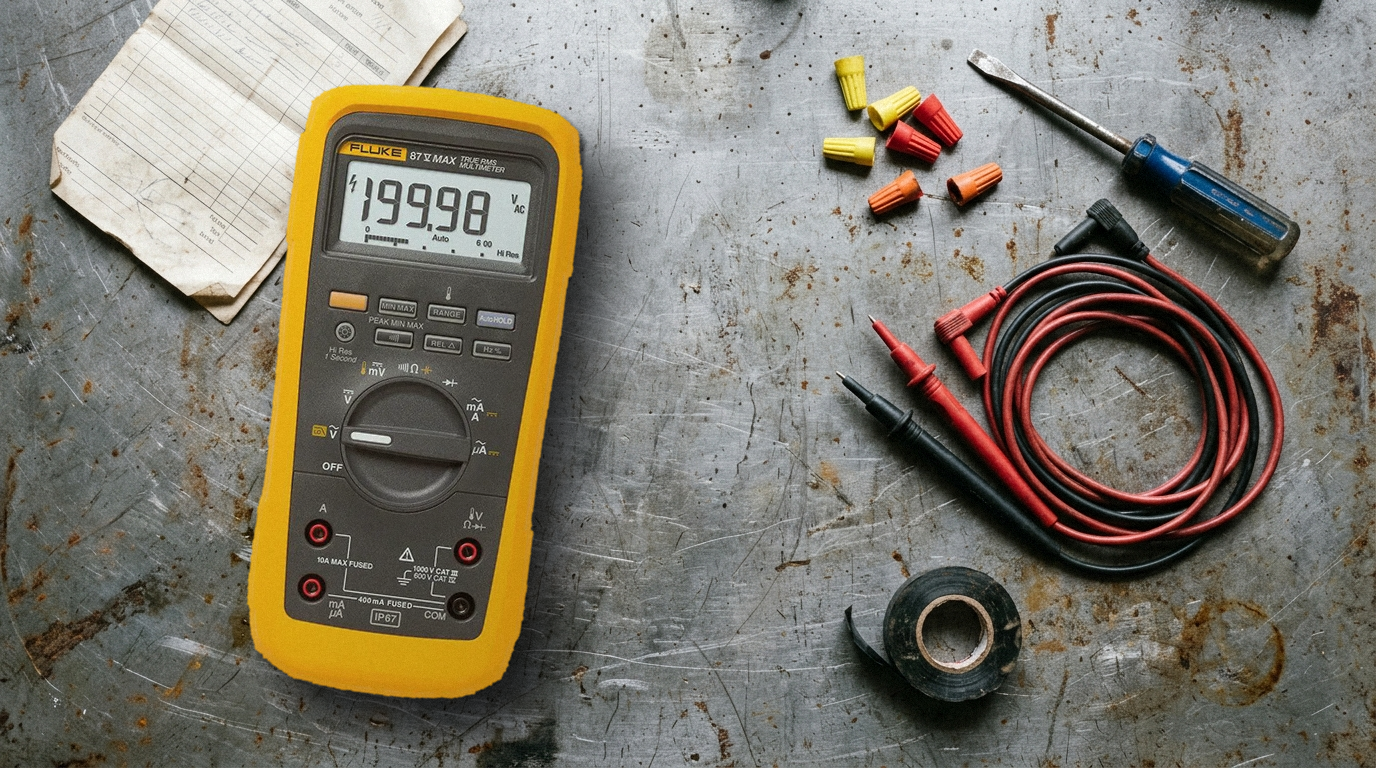
| 87V | 2004 | 6,000 counts, 19,999 high-res | 0.05% | Yes, probe included | Yes | Open the case | 1000 V CAT III, 600 V CAT IV | $230 to $539 | $579.99 list |
| 87V MAX | 2019 | 6,000 counts, 19,999 high-res | 0.05% | Yes, probe included | Yes | Fuse door behind battery door | 1000 V CAT III, 600 V CAT IV, IP67 | $339 to $639 | $654.99 list |
Specs from Fluke's users manuals and product pages. Every generation is true-RMS on AC volts.
Generation by generation
The original Fluke 87 (1988)
The meter that set the shape everyone still copies: dark face, yellow holster, big rotary switch. It reads 4,000 counts with a 19,999-count high-resolution mode, does true-RMS AC, and has min/max with a 1 ms peak capture. Fluke's own history dates it to 1987; the first users manual is dated August 1988. It was made in Everett, Washington.
Two things matter used. First, there is no battery door. Changing the 9 V battery or a fuse means opening the case, so look for stripped screws, cracked snaps and a pinched battery lead. Second, early units carry no CAT rating on the label. Later ones are marked 1000 V CAT III. Faded digits are a known fault on these, usually caused by a dirty contact between the display's rubber connector strips and the board, which cleans up.
There was no 87 II. Fluke went from the 87 to the 87 III. A listing that says "87 II" is almost certainly an 87 III.
Fluke 87 III (1997)
The used market's workhorse, and the best value in the family. Same 4,000 and 19,999 count display as the original, but basic DC accuracy tightened to 0.05%, peak capture got faster at 250 microseconds, and a battery door arrived. Fuses still need the case opened. It does not measure temperature.
The 87 III is what most people searching "Fluke 87" are actually buying: 83 used US listings on 1 Oct against 49 for the 87V, at about half the price. Tested units with leads clustered at $175 to $200, which is a fair guide to the going rate. Anything much above $250 should come with something extra, such as a current clamp or a recent calibration certificate.
Fluke 87 IV (1999)
The odd one out. The 87 IV is a different design: 50,000 counts with a dual display, 0.025% basic DC accuracy, AC to 100 kHz, temperature, four AA batteries and an IP42 rating. Fuses come out through the battery door without opening the case. Fluke's documentation groups it with the 187 and 189, and owners generally treat those as its successors.
It is scarce. We found two in the US on 1 Oct, at $350 and $400. If you want its features, a used 187 or 189 is easier to find.
Fluke 87V (2004)
The current model, sold under the order code 87-5. Fluke says it is designed and built in the US. Over the 87 III it adds a 6,000-count display, built-in temperature with a probe in the box, a 600 V CAT IV rating, a capacitance range to 10,000 microfarads, and a selectable low-pass filter for reading the output of variable frequency drives, which is the feature electricians buy it for. Fuses still sit inside the case.
Used, the 87V asked $230 to $539 with a median of $360. That is about 22% under the cheapest dealer price we found ($459.95) and 38% under list. Against that saving, Fluke's lifetime warranty "covers the original purchaser only and is not transferable", so a used meter has none. If you are going to spend $360 or more, a new one is worth pricing first.
The 88V is the automotive sibling on the same platform with the same fuses. It is average-responding rather than true-RMS, so do not buy it as a cheaper 87V. The 83V is the stripped-down 80 Series V model.
Fluke 87V MAX (2019)
The rugged version: IP67 sealing, a 4 m drop rating, three AA batteries, a fuse door you reach through the battery compartment, and accuracy specified for two years after calibration instead of one. Fluke calls it its first IP67 multimeter. The measurement spec is otherwise the 87V's.
Used, five listings asked $339 to $639, median $425, against $532.95 at the cheapest dealer and $654.99 list. It is the newest generation, so there are few on the used market and no failure pattern yet.
What each one costs used and new
| Model | Used asking, US, 1 Oct 2026 | Median | Listings | New, lowest dealer | New, Fluke list |
|---|---|---|---|---|---|
| Original 87 | $120 to $339 | $170 | 15 | Discontinued | |
| Fluke 87 III | $150 to $320 | $199 | 33 | Discontinued | |
| Fluke 87 IV | $350 to $400 | thin | 2 | Discontinued | |
| Fluke 87V | $230 to $539 | $360 | 11 | $459.95 | $579.99 |
| Fluke 87V MAX | $339 to $639 | $425 | 5 | $532.95 | $654.99 |
Used: item price without shipping, US sellers, working units, bare meter or meter with leads and holster; kits, lots, parts units and live auctions excluded. Asking prices, sampled through eBay search on 1 Oct 2026; most are Best Offer, so expect to pay somewhat less. New: Fluke.com list and the lowest of Tequipment, Transcat, Test Equipment Depot and Cole-Parmer on the same day.
Kits carry a premium. An 87V with an i400 current clamp and hard case asked $430; an 87 III with an 80i-400 clamp asked $250; a used 87V MAX/E2 combo kit asked $550 against $712.11 new.
How to spot a fake or a rebuilt meter
Fluke publishes general counterfeit warnings: flawed fonts, wrong colours, poor packaging and a price well below authorised dealers. It also says it cannot repair or replace a counterfeit. We could not find a reliable teardown of a fake 87V, so instead of guessing at tells, check the meter against Fluke's own numbers:
- Weight: an 87V is 355 g bare and 624 g in its holster. An 87V MAX is 517 g bare.
- Fuses: 440 mA and 11 A, both 1000 V, Fluke parts 943121 and 803293 (Bussmann DMM-44/100 and DMM-11). Genuine Bussmann DMM fuses are sand-filled, in a tube with a maroon 1000 V band. A meter with glass or unbranded fuses has either been worked on carelessly or is not what it claims.
- Battery: one 9 V behind a door with quarter-turn screws on the 87 III and 87V; three AA on the MAX.
- Serial number: on the back, under the holster.
- Origin: Fluke says the 87V is built in the US. A "made in China" 87V is not proof of a fake, but it is a reason to ask questions.
Two things we saw in the 1 Oct listings are worth knowing. Replacement 87V front shells, back cases, battery doors, buttons and LCDs are all sold separately on eBay for about $12 to $61 each, so a clean case says nothing about the board inside. And a block of overseas listings offered 87 IIIs and 87Vs at $187 to $500. We did not count them. Even if genuine, Fluke says warranty service is only available in the country where the meter was first bought.
What to check before you bid
- Serial number and battery compartment. Ask for photos of both. On an 87V, check the serial against the safety notice range and look for the corrected-unit sticker. Look for battery leakage on every generation.
- Display. On an 87V, holding HOLD while switching on lights every segment. Missing segments mean a display or connector problem.
- Fuses. Set the dial to ohms, put a lead in the V/ohm jack and touch the probe to the A jack: 0.0 to 0.5 ohms means the 11 A fuse is good. Touch it to the mA jack: about 1 kilohm (0.995 to 1.005) means the 440 mA fuse is good. OL means blown.
- Every switch position. Turn through each one. Ranges that hunt between kilohms and megohms can mean a rotary switch contact bent by a previous owner's repair.
- Signs the case has been opened. Chewed screw heads, crushed plastic or a missing seal. Opening an original 87 is normal for a battery change; on an 87V it means fuse work or a repair.
- Input jacks. A meter that beeps "lead in wrong jack" with nothing plugged in usually has moisture or dirt in the current jacks.
- Test leads. Leads rated lower than the meter undo the meter's rating. Fluke TL75 or TL175 leads are the standard; replace any that are cracked or missing.
- Returns. Buy from sellers who accept returns on a meter described as working, and test it the day it arrives.
A listing that says "calibrated" without a certificate means little. What a certificate does and does not tell you is in what "out of cal" actually means. If you need one for work, an accredited calibration of an 87V with data costs about $215 to $221 from Cole-Parmer's InnoCal service or Transcat.
If you are also shopping for a bench scope, the same approach applies in the used oscilloscope buyer's guide.
FAQ
Is the Fluke 87 III still worth buying?
Yes, for most electrical work. At about $200 used it is true-RMS, rated 1000 V CAT III, and accurate to 0.05% on DC volts, which is the same basic accuracy as the 87V. What you give up against the 87V is temperature, the CAT IV rating and the low-pass filter for drives.
What is the difference between the 87V and the 87V MAX?
The measurements are the same. The MAX adds IP67 dust and water sealing, a 4 m drop rating, three AA batteries instead of a 9 V, fuse access without opening the case, and a two-year calibration spec instead of one. Used, it asked about $65 more than an 87V at the median on 1 Oct 2026.
Does Fluke's lifetime warranty transfer to a used meter?
No. Fluke's warranty text says it covers the original purchaser only and is not transferable, and it requires purchase from an authorised seller. A used listing that promises a lifetime warranty is promising something Fluke does not offer a second owner. The free safety notice repair is separate and does not ask for proof of purchase.
How much does it cost to calibrate a Fluke 87V?
An accredited ISO 17025 calibration with data costs about $215 to $221 from Cole-Parmer's InnoCal service or Transcat, based on prices published on 1 Oct 2026. Calibrations with no accreditation claim are advertised from $85. Fluke specifies the 87V's accuracy for one year after calibration and the 87V MAX's for two.
How do I know if my 87V is part of the recall?
Read the serial number on the back under the holster. Fluke's safety notice covers 83V, 87V and 88V meters with serials 46280001 to 55370001, made between June 2019 and August 2021. If yours is in range and has no blue or green sticker in the battery compartment, run Fluke's COM jack test or register it for the free repair on Fluke's safety notice page.