The short answer
A used robotic total station pays for itself when you regularly put one person in the field where you used to put two. If you already run two-person crews, do layout and as-built work only, or cannot stretch to the controller and prism a robotic needs before it does anything, a manual instrument is the right buy.
On eBay US, sampled 28 Sep 2026, a working manual instrument asks $1,200 to $7,500 depending on tier and a bare robotic asks $5,000 to $30,000. Add the controller, prism, radio and batteries a robotic cannot work without and the all-in used robotic range is about $7,300 to $31,000, against $1,500 to $8,000 for a manual with a prism and a spare battery. Bands are from the used total station price guide.
On eBay now
What "robotic" actually means
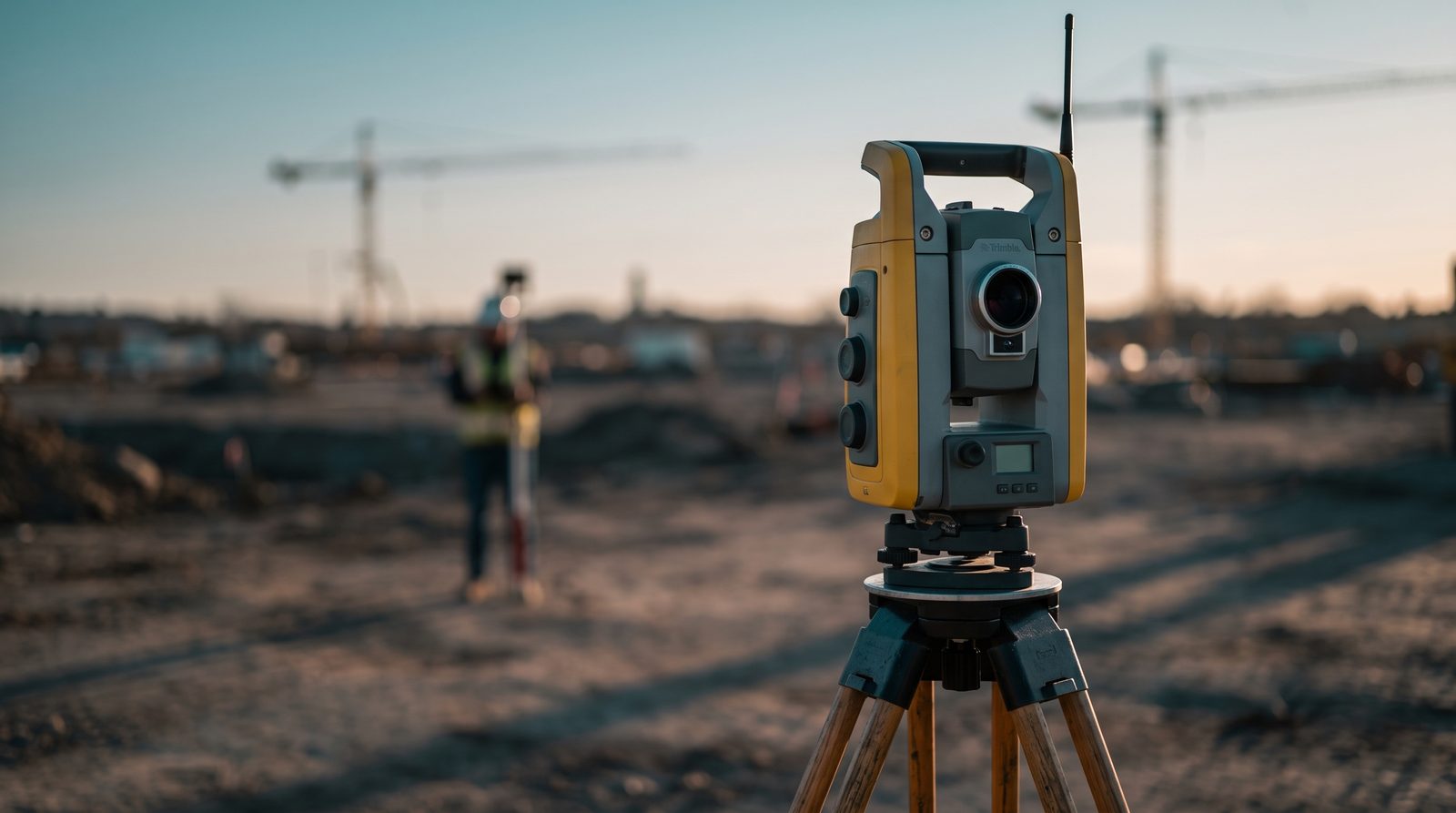
A manual total station you point by hand. A robotic one adds four things.
Servo drives. Motors turn the instrument on both axes. Trimble's MagDrive is an electromagnetic direct drive the S6 datasheet rates at 115 degrees per second and 3.2 seconds to flip face. Servo alone only means the instrument can point itself at a coordinate you type in.
Prism tracking. A sensor beside the telescope sees the prism and keeps the crosshair on it as the pole moves. Trimble calls it Autolock, Leica calls it ATR (ATRplus on the TS16), Topcon builds it into the PS and GT series. The S6 datasheet gives lock range as 500 to 700 m on a passive prism and 800 m on the MultiTrack active target. Leica publishes ATRplus on the TS16 to around 1,000 m on a 360 prism.
Search. When lock drops the instrument has to find the prism again. Trimble uses a search window and, with the MT1000, GPS Search from the rover position. Leica PowerSearch sweeps a vertical laser fan through 360 degrees, published range about 300 m. Topcon's RC-5 handle on the pole fires an infrared signal that points the instrument straight back at you: quick lock.
A radio link to a controller. You are at the pole, so the keyboard is 200 m away. A 2.4 GHz radio (Trimble) or a radio handle (Leica RH15, RH16, RH17) talks to a controller on the pole: Trimble TSC3, TSC5 or TSC7, Leica CS15 or CS20, Topcon FC-5000. The controller runs the software and holds the licence.
Active versus passive prism. A passive prism is glass, and a road sign or another crew's prism can steal lock. An active target such as the Trimble MT1000 carries a ring of LEDs on a channel the instrument is set to, so it locks to your pole and nobody else's. It costs more and needs its own battery.
A robotic with no controller, no radio and one round prism is a manual instrument that can turn itself around. The instrument is half the kit.
What each costs used, all in
Instrument bands are from the used total station price guide, sampled 28 Sep 2026. Accessory bands were sampled 29 Sep 2026, used, US only, sorted price plus shipping. Both are asking prices; sold prices arrive in the 1 Oct report, and the method is in how our price reports work.
| Kit | Bare instrument | Controller and licence | Prism | Radio | Batteries and charger | All in |
|---|---|---|---|---|---|---|
| Manual: Leica TS06 Plus, Topcon GM-52 | $5,900 to $7,350 | Not needed, onboard software | Single prism $30 to $125 | None | $70 to $400 | $6,000 to $7,900 |
| Previous-gen robotic: Trimble S6, Leica TS12/TS15, Topcon PS-103 | $4,600 to $15,200 | Trimble TSC3 with Access $1,150 to $1,350; Leica CS15 $500 to $1,000; Topcon FC-5000 $1,850 to $2,200 | Trimble 360 prism $395 to $650 or MT1000 $1,650 to $3,000; Leica GRZ4 $450 to $550; Topcon ATP1 $1,225 | Usually inside the instrument; S6 2.4 GHz side cover $1,200 as a part; Leica RH15 $195 to $900; Topcon RC-5 $2,500 to $2,750 (required for quick lock) | $125 to $450 | $7,300 to $18,000 |
| Current-minus-one robotic: Trimble S5, S7, Leica TS16, Topcon GT-503/GT-1003 | $6,500 to $30,000 | Trimble TSC7 $3,900 to $6,300 (no bare TSC5 in the US used sample); Leica CS20 $3,600 to $4,650; Topcon FC-5000 $1,850 to $2,200 | MT1000 $1,650 to $3,000; Leica GRZ122 $410 to $1,175; Topcon ATP1 $1,225 | Trimble EM120 2.4 GHz module $1,650 if the TSC7 lacks one; Leica RH16/RH17 not listed bare on the sample date; Topcon RC-5 $2,500 to $2,750 | $125 to $450 | $12,400 to $31,000 |
Three things the table hides. The S7 listings at $19,000 to $30,000 are dealer kits with a TSC5 already in them, so do not add a controller twice. The $500 CS15 is one seller with a dozen identical units and no software stated; a CS15 with SmartWorx and a robotic licence was $998. And the PS-103 is the cheapest robotic body on the market at $4,600, but the RC-5 it needs for quick lock costs more than half the instrument.
If your budget is the $2,500 to $4,500 mid-manual tier (Leica TS02, Nikon Nivo, Sokkia CX-105), the honest comparison is $3,000 to $5,000 for a manual kit against $10,000 to $12,000 for a tested previous-gen robotic with a working controller. That is the gap to price.
The payback maths
Assumptions first. A rodman or instrument person in the US costs a small firm somewhere around $250 to $350 per crew-day once wages, payroll cost and a share of the truck are in. That is an assumption for the arithmetic, not a survey. Use your own number.
Take a $6,000 gap: a $4,500 manual kit against a $10,500 previous-gen robotic kit with a tested controller.
- Amortise the gap over 24 months: $6,000 / 24 = $250 per month.
- Add the licence. A one-year Leica Basic CCP for a TS16 listed at $841 and a 12-month Topcon MAGNET Field subscription at $825, so call it $70 per month. Trimble Access maintenance is priced by the dealer.
- Add a repair contingency for the servo and tracking risk: $1,500 over 24 months is $63 per month.
- Monthly cost of going robotic: about $383.
At $300 per crew-day, break-even is $383 / $300 = 1.3 crew-days per month. At $250 it is 1.5 days; at $350 it is 1.1. If the robotic sends one person instead of two on two days a month or more, it pays. At five solo days a month it clears about $1,100 a month after costs.
On a $12,000 gap (a mid manual against a Trimble S5 or Leica TS16 kit at $16,000 to $17,000): $500 per month plus $133 in licence and contingency is $633, or 2.1 crew-days a month at $300.
Where it does not pay: occasional layout where a helper is already on site, hobby and student use, and any firm that will keep sending two people anyway for safety, traffic control or hauling. The saving only exists on days the second person actually stays home. Count those days before you count the money.
Where used robotics go wrong
A manual instrument has an EDM, a compensator and an angle system to fail. A robotic adds three more, and they are the expensive ones.
Servo and drive boards. They run every time the instrument moves, and a ten-year-old S6 or TS12 has moved a great deal. Symptoms are a whine or grind on rotation, hunting around the target, or one axis that turns and one that does not. Servo side covers and drive assemblies sell as parts at $325 to $1,200 on eBay, which tells you what the trade thinks a failed one is worth. Ask for a video of a full face flip and a 360 degree search. Nobody we found publishes a board repair price; ask the dealer for a quote before you bid.
Tracking sensor. ATR and Autolock are a camera and an optical path aligned to the telescope, and that alignment drifts and gets knocked. A robotic that locks but measures a few millimetres off the prism centre at 100 m has a collimation problem; one that will not lock at all has a dead sensor. This is calibration in the sense the name of this site means, and what "out of cal" actually means covers it. One US service centre lists a robotic service, including ATR and PowerSearch power-level reset and a compensator check, at $500, parts extra. Budget that as a minimum on any robotic bought from a non-dealer.
Controller licences that lapse. Trimble Access on a perpetual licence keeps running after the maintenance date but cannot load a newer version, and a dealer on a surveyors' forum put it plainly: reinstatement cost steps up after 90 days and again after 12 months. Leica CCP is a 12-month package; renew late and the new end date runs from the old expiry, not from today. Topcon MAGNET Field on subscription reverts to demo mode when the 12 months are up. A TSC3 on "Access 2017" is end of life and will never update; fine if 2017 does what you need, a trap if the listing says "latest software". Ask for a photo of the licence expiry screen.
The compensator sits under all three. A robotic that hunts for level or throws a tilt error on a solid tripod is a mainboard job on top of whatever else is wrong.
When a manual instrument is the better buy
- You run two-person crews and will keep running them. The robotic saves nothing.
- Your work is layout and as-built on busy sites, with a helper already there and reflective surfaces stealing lock.
- Your all-in budget is under $6,000. A tested manual with a prism beats an untested robotic with no controller every time.
- Remote sites, long days, no spare. A dead radio or flat controller ends a robotic day; a manual keeps measuring.
- It is your first instrument. Learn the peg test and the collimation check on a body with fewer things to break.
- You need 1" or 2" on a small budget. A 2" manual is $3,000 to $7,000; a 2" robotic starts north of $10,000 bare.
Robotic models worth looking at used, by budget
Under $10,000 all in
- Topcon PS-103: $4,600 to $6,400 bare. Needs the RC-5 ($2,500 to $2,750) for quick lock and an FC-5000 or FC-500 with MAGNET. Watch for PS-103A versus MC firmware, and whether the RC-5 is actually in the box.
- Trimble S6: $5,250 to $11,500 bare. DR300+ versus DR Plus. Batteries $125 each. Pair with a TSC3 on Access ($1,150 to $1,350 with the internal radio) and a Trimble 360 prism.
$10,000 to $18,000 all in
- Leica TS12: $10,500 to $13,700 bare. Needs CS10/CS15. RH16 handle. GEB222 batteries.
- Leica TS15: $10,000 to $15,200. Suffix matters: P has PowerSearch, A is ATR only, I is imaging. A CS15 at $700 to $1,000 keeps the controller cheap.
- Trimble S5: $8,000 to $16,000 bare. Check Access expiry on any bundled TSC7 and that the 2.4 GHz module is present.
- Topcon GT-503/GT-1003: $6,500 to $8,050 bare, 800 m reflectorless. FC-5000 adds $1,850 to $2,200, RC-5 another $2,500.
Over $18,000 all in
- Leica TS16: $12,000 to $24,700 bare, CS20 kits $17,000 to $18,500. Ask for the CCP end date; 5" R500 is the value grade.
- Trimble S7: $19,000 to $30,000, nearly all dealer kits with TSC5. Confirm the scanning licence and the Access date.
What to check before you bid (robotic-specific)
- Tracking lock at 100 m or more. Video of the instrument locking, following a walking pole and re-acquiring after the prism is hidden. A demo at 10 m proves nothing.
- Servo noise and speed. A full turn and a face flip on video. Grinding, stalling or a slow axis is a board.
- Radio pairing with the included controller. Not "has a radio" but "this controller talks to this instrument". Ask for a screenshot of the connected status.
- Licence expiry screen. Photo of the Access, Captivate or MAGNET about screen with version and maintenance or subscription date.
- Compensator. Settles and holds on a level tripod; no tilt errors.
- Battery age and count. Robotic work burns packs faster. Two working OEM packs and a charger, or price $125 to $450 to replace them.
- Prism type included. Round, 360 or active, and the constant. An MT1000 with a dead battery is a $1,650 to $3,000 line item.
- Return policy. Filter for it. You need 30 days to run the peg test, the lock test and a radio range test.
FAQ
Can a robotic total station be used manually? Yes. Every robotic instrument can be pointed by hand or from its own keyboard and used as a conventional total station. Trimble instruments still want a controller for most functions; Leica and Topcon robotics run onboard software without one. A robotic with a dead radio is a slow manual instrument, not a brick.
Do I need a data collector with a robotic total station? For one-person work, yes. The controller on the pole is how you drive the instrument from the prism end. Leica and Topcon robotics can run two-person from the onboard keyboard, and some Trimble models take a face-mounted CU. Budget $500 to $6,300 for the controller depending on generation, and check its licence before the instrument.
How far can a robotic total station track a prism? Manufacturer figures run from about 500 m to 1,000 m depending on prism type and conditions. The Trimble S6 datasheet gives 500 to 700 m on a passive prism and 800 m on the MT1000 active target. Leica quotes ATRplus on the TS16 to around 1,000 m on a 360 prism. In practice heat shimmer, rain and traffic cut those numbers, and radio range often limits you first.
Is a 15-year-old Trimble S6 still worth buying? At $5,250 to $8,000 bare, yes, if the servo, Autolock and radio check out and a TSC3 with a working Access licence is in the deal or priced in. It measures to the same specification it did new. What has aged is the batteries, the boards and the software path; the TSC3 tops out at Access 2017. Buy from a seller who takes returns and budget a $500 service.
What's the cheapest way into a one-person crew? A Topcon PS-103 with RC-5 and FC-500, or a Trimble S6 with a TSC3, a 360 prism and two fresh batteries, each lands around $8,000 to $11,000 all in on current asking prices. Below that you are buying a bare body and hoping the accessories turn up at auction, which works, but takes months.
These are asking prices from one sampling week. Sold prices for the same robotic models land in Thursday's first used total station price report. Check the date on this page, then the live listings, then the instrument on a tripod.
On eBay now